
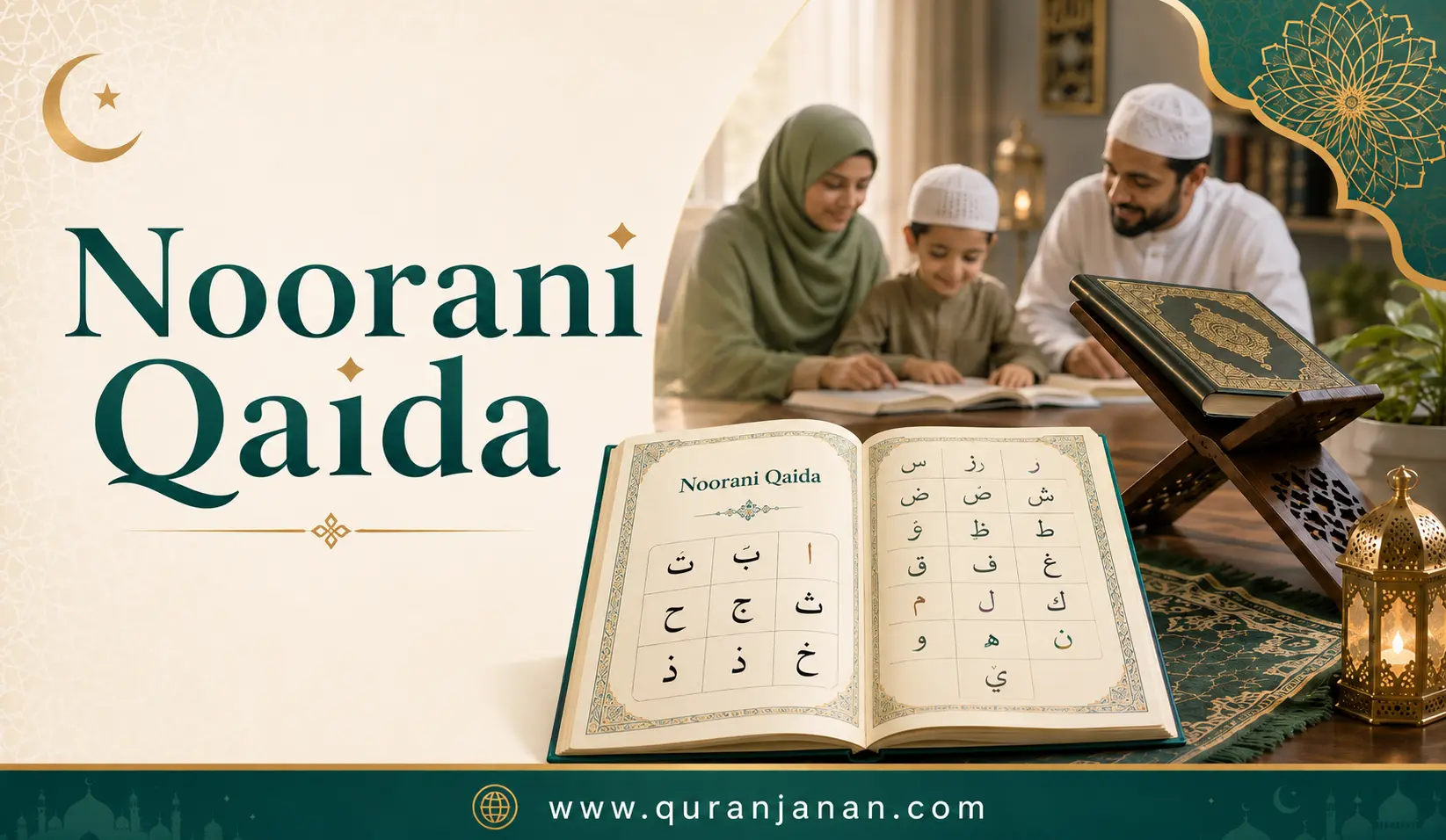
Noorani Qaida is a beginner’s guide to reading the Quran that teaches step-by-step the Arabic letters, pronunciation, conjugation, vowels, and basic recitation principles.
It helps children, adults, and new learners build a strong foundation before they can read the Quran fluently.
For Muslim families, Noorani Qaida can make learning the Quran at home easier, calmer, and more organised with teacher guidance.
Introduction
A mother sits with her child. The Quran is on the table, the room is peaceful, and the child is trying to recognise the Arabic letters. Some letters look the same. Some sounds feel new. The parent wants to help, but they silently wonder, “Where should we start before reading the Quran?”
Many adult beginners feel the same way. They love the Quran, but they don’t know the Arabic letters, movements, conjugation, pronunciation, or the basics of reading. Some learned them as children but forgot them. Some are starting for the first time.
Noorani Qaida is one of the most helpful introductory books for learning to read the Quran. It teaches beginners how Arabic letters sound, how they are combined, how letters work, and how to read Quranic words correctly with gradual practice.
In this guide, you will learn what Noorani Qaida is, why it is important in Islam, how to learn Noorani Qaida step by step, how many lessons a Noorani Qaida usually has, common mistakes to avoid, and how Quran Janan Academy helps children and adults through online Quran classes.
What is Noorani Qaida?
Simple Definition
Noorani Qaida is a beginner Quran reading book that teaches Arabic letters, sounds, consonants, conjugations, pronunciation, and the basic principles needed before reading the Quran fluently.
In simple terms, it is a bridge between not knowing Arabic letters and being able to read Quranic words. Certified Quran teachers often recommend Noorani Qaida for children and adults because it builds the foundation slowly and clearly.
Common Misconceptions.
A common misconception is that Noorani Qaida is only for children. This is not true.
Noorani Qaida is useful for anyone who wants to learn to read the Quran from scratch. Many adults start with Qa’ida because they want to improve their Arabic reading, correct old mistakes, or learn to recite the Quran with better pronunciation.
Another misconception is that students should skip Noorani Qaida and start directly with the Quran. Some students may be able to do this, but most beginners benefit from learning the letters, movements, conjugations, and pronunciation first. This prevents confusion later.
Question: What is Noorani Qaida?
Noorani Qaida is a beginner-level Quran reading guide that teaches the basic principles of Arabic letters, vowels, conjugations, pronunciation, and recitation. It helps prepare students to recite the Quran correctly and confidently.
Why is the Noorani Qaida important in Islam?
The Noorani Qaida is important because it helps students begin their journey of learning the Quran with clarity and respect. The Quran is the book of Allah, and Muslims recite it in prayer, read it at home, teach it to children, and listen to it with love.
Islamic education teaches that recitation of the Quran should be clear, careful, and measured. Therefore, beginners should not rush. The Noorani Qaida helps the student understand the Arabic sounds before moving on to reading the full Quran.
The Prophet Muhammad (peace and blessings of Allah be upon him) encouraged learning and teaching the Quran. It gives a special honour to Quranic learning and reminds families that even the first step — learning a single letter correctly — is important when done with sincerity.
The Noorani Qaida also supports Salah. When a student learns the Arabic letters and pronunciation, he can improve his recitation of Surah Al-Fatiha, short surahs, and daily recitation. For those who voluntarily pray, stay up in the last third of the night, or pray after prayer, better Quran recitation can make worship feel more focused and meaningful.
Question: Why should beginners learn Noorani Qaida?
Beginners should learn Noorani Qaida because it teaches the basics of Quran recitation step by step. It helps students recognise Arabic letters, pronounce words correctly, avoid common mistakes, and prepare for fluent Quran recitation.
For Muslim families, Noorani Qaida also creates a peaceful learning routine at home. A child who learns the letters and sounds correctly will feel more confident when reading the Quran later. An adult who starts with Qaida may feel less shy and more optimistic.
How to Learn Noorani Qaida Step by Step
Learning Noorani Qaida is easier when the process is gentle and systematic. Don’t try to finish everything quickly. The goal is not speed. The goal is to read correctly and make steady progress.
Step 1: Start with Arabic letters.
The first step is to learn Arabic letters. A beginner should recognise each letter, understand its sound, and practise it gradually.
Some letters may look the same, and some sounds may not exist in the same way in English or Urdu. Therefore, teacher correction is helpful. A kind teacher will repeat the sound, show the student how to pronounce it, and give short practice.
For children, this step should feel light and encouraging. For adults, it should feel respectful and free from pressure.
Step 2: Learn movement and involvement.
After the letters, students learn movements such as Fatiha, Kasrah, and Dummah. These small marks change how the letter is read.
Then, students learn how Arabic letters are connected. This step is very important because Quranic words are not just read letter by letter; students need to understand how letters are connected and how sounds are made.
Competent Quran teachers often recommend a slow daily review of this step; even 10 minutes a day can make a big difference.
Step 3: Practise Sukn, Madd, Shadd, and the basic rules.
Once the student understands the letters and their pronunciation, he can move on to Sukn, Madd, Shadd, Tanween, and other basic rules of reading. These lessons prepare the student for Quranic words and short verses.
This is where many students start to feel progress. A child may start to recognise Quranic words. An adult may feel, “Now I understand how reading works.”
Featured Best Answer
How to Learn the Noorani Rule:
- Learn Arabic Letters and their sounds.
- Practice movements such as Fath, Kasra and Damma.
- Learn how to combine letters into words.
- Study Saqoon, Mudd, Shadd and Tanween.
- Read short Quranic words slowly.
- Revise daily with a teacher.
- Progress gradually to Quranic recitation.
Step 4: Read with a qualified Quran teacher
Self-study can help, but correction from teachers is very important. A student can repeat the same mistake for weeks without noticing it. A qualified Quran teacher listens attentively and corrects pronunciation, articulation, pauses and fluency.
For example, a 7-year-old may initially confuse similar letters; the teacher gently repeats the sounds and gives short words to practise. After a few weeks, the child starts recognising the letters. Parents feel relieved because the learning journey has now begun.
Question: How to learn Noorani Qa’id online?
You can learn Noorani Qaida online through live lessons with a qualified Quran teacher. The teacher listens, corrects pronunciation, explains each lesson, practises, and helps the student progress to reading the Quran from Arabic letters.
How many lessons are in Noorani Qaida?
Many versions of Noorani Qaida are taught in approximately 17 lessons, although the lesson names and page structure may vary slightly depending on the edition or teacher.
Lessons usually start with Arabic letters and gradually progress to movement, inclusion, sukun, mudd, tanween, shuddah, and basic rules that prepare students for reciting the Quran.
An easy way to learn might look like this:
- Arabic letters
- Combined letters
- Movement
- Tanween
- Sukoon
- Med letters
- Lane letters
- Shudda
- Noon Sakina Qaida
- Meem Sakina Qaida
- Word-reading practice
- Quranic vocabulary fluency
- Quranic words fluency
Question: How many lessons are there in Noorani Qaida?
Noorani Qaida usually has about 17 lessons, depending on the edition used. These lessons gradually teach the Arabic letters, vowels, conjugations, pronunciation, and the basic reading principles necessary for reciting the Quran.
The number of lessons is not the most important thing. What is more important is whether the student understands each lesson properly before moving on.
Common mistakes and how to avoid them.
Every beginner makes mistakes. This is normal. The goal of Noorani Qaida is to teach gradually, so students should not feel embarrassed.
Mistake 1: Rushing through lessons
Some parents want their children to finish the Qada quickly. Some adults want quick results, too. But rushing often leads to poor reading.
The solution is simple: only move when the student can clearly read the current lesson.
Mistake 2: Ignoring pronunciation
A student may recognise the letters but may mispronounce them. This can cause problems later in reciting the Quran.
The practice sounds careworn. Let the teacher correct the letters with the throat, tongue, and lips. Clear pronunciation is important from the beginning.
Mistake 3: Not reviewing daily
The Noorani Qa’id needs to be repeated. If a student only practises during class and does nothing between lessons, progress slows down.
A short daily routine is better than one long lesson every now and then. A five- to ten-minute review can help children and adults remember better.
What mistakes should I avoid?
Avoid rushing through the Noorani Qa’id, ignore pronunciation, and skip daily revision. Learning the rules has become important.
How Quran Janan Academy helps students.
Quran Janan Academy helps children, adults, and Muslim families through online Quran learning that fits into home life. The goal is not to rush students, but to help them build a sincere and lasting relationship with the Quran.
For beginners, Quran Janan Academy offers Noorani Qaida classes so that students can learn Arabic letters, movements, joining, pronunciation, and basic Quran recitation step by step.
For children, Quran for Kids classes make learning gentle, structured, and age-appropriate. A child can start with Qaida, progress to smaller Surahs, and gradually build the confidence to read the Quran.
For adults, Quran for Adults classes allow learners to start without embarrassment. Adult students can ask questions freely and practise at their own pace.
For students who can already read, Tajweed classes help improve pronunciation and Quran recitation. For students who want to memorise, the Hifz programme supports memorisation with revision and teacher guidance.
Quran Janan Academy also offers female Quran teachers for sisters and families who prefer female education. Online Quran classes provide personalised attention and correction to each student.
Free trial classes can help families understand the student’s current level before choosing a regular plan.
Frequently Asked Questions
1. What is Noorani Qaida?
The Noorani Qaida is a beginner Quran reading book that teaches the basic principles of Arabic letters, sounds, vowels, conjugations, and recitation. It helps children and adults prepare to read the Quran correctly. Students usually start with letters and gradually move on to Quranic words. Tip: Start with a qualified teacher for correct pronunciation.
2. How to learn Noorani Qaida at home?
You can learn Noorani Qaida at home by following a short daily routine with teacher guidance. Start with the Arabic letters, then move on to reading the movement, sukun, mudd, and short words. Keep the lessons simple and consistent. Tip: Practice for five to ten minutes a day rather than rushing through too many pages.
3. How many lessons are in Noorani Qa’id?
Depending on the edition, Noorani Qa’id usually has 17 lessons. These lessons usually start with the Arabic letters and progress to the basic rules of sukun, mudd, shadda, and reading. The goal is to prepare for reciting the Quran. Tip: Focus on understanding each lesson, not just finishing quickly.
4. Can adults learn Noorani Qa’id online?
Yes, adults can learn Noorani Qa’id online with a qualified Quran teacher. Many adults start from scratch to correct old mistakes, improve pronunciation, or learn to read the Quran correctly. Online classes make learning private and flexible. Tip: Start with an assessment so the teacher can understand your level.
5. Is Noorani Qaida enough for Quran recitation?
Noorani Qaida laid the foundation for Quran recitation, but students still need practice and teacher correction. After Quaid-e-Azam, students should recite short Quranic lines, improve fluency, and learn basic Tajweed. This helps them to recite the Quran with confidence. Tip: Continue lessons after finishing the Qaida.
6. What type of Noorani Qaida class is best for children?
One-on-one Noorani Qaida classes are often best for children because the teacher can focus on correcting the child’s mistakes. Children need repetition, encouragement, and age-appropriate lessons. Group classes can help some students, but beginners often need personal correction. Tip: Choose a patient teacher who teaches gently.
Conclusion
Noorani Qaida is a beautiful first step for anyone who wants to recite the Quran with confidence. It gradually teaches Arabic letters, sounds, movements, conjugations, pronunciation, and basic principles.
For children, it builds a strong foundation for reading the Quran. For adults, it offers a respectful new beginning. For Muslim families, it brings Quran learning into the home with structure, comfort, and purpose.
Start small. Learn one letter. Practice one sound. Read a short lesson. With sincerity and guidance from teachers, a bright leader can open the door to a lifetime of Quran recitation.
Start your free trial class today.